
QUESTIONS ABOUT MACHINE VISION? START HERE.
Answers to common questions about machine vision inspection, CMVS measurement systems, manufacturing applications, industrial integration, thermal inspection and CORPEX technology.
Measurement C29, models, accuracy and production control Inspection &
Applications Machine vision, computer vision, defects and EMVS Integration &
Data PLC, SCADA, MES and production information Thermal, Safety &
Efficiency Temperature, safety, waste and sustainability Tribal IQ &
Knowledge AI, workforce knowledge and operational intelligence
Cable measurement and production control
What is CMVS and how does it improve cable and wire manufacturing?
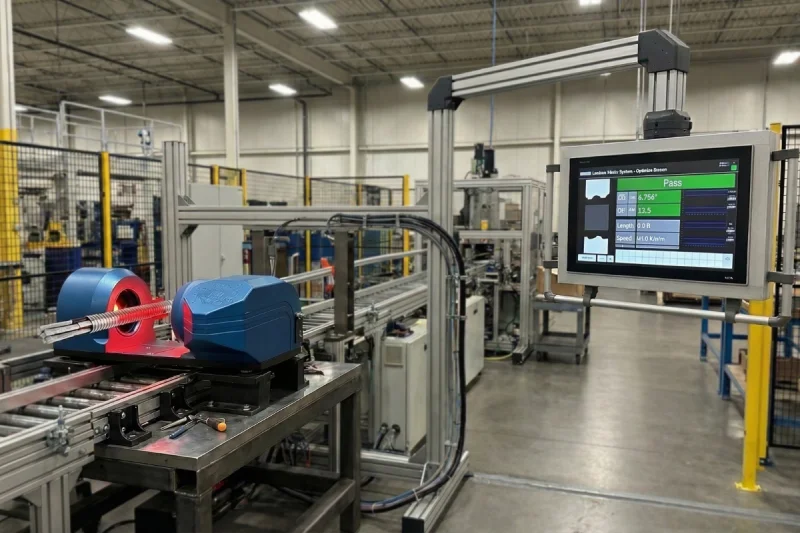
CMVS, the Cable Measuring Vision System, uses machine vision to continuously measure critical product characteristics such as outside diameter, convolution pitch and length while the product is moving through production.
When configured with production controls, inspection information can be communicated to the PLC so operators can identify dimensional variation quickly and the production process can respond to out-of-spec conditions.
What CMVS models does CORPEX offer?
CORPEX offers several CMVS systems for different product sizes, production environments and measurement requirements.
- CMVS C29 Express : Compact, all-in-one machine vision system for continuous dimensional measurement during cable production, with accuracy up to ±0.001″. It can operate standalone or integrate with existing production systems.
- CMVS 35 : 0.15″ to 1.35″ OD, with accuracy up to ±0.001″ and production speeds up to 80 ft/min.
- CMVS 55 : 0.25″ to 2.2″ OD, with accuracy up to ±0.002″.
- CMVS 100 : 0.25″ to 4.0″ OD, with accuracy up to ±0.002″.
- CMVS 125 : 0.25″ to 5.0″ OD, with accuracy up to ±0.002″.
- CMVS 125 Dual Axis: Designed for flat products requiring width and height measurement.
How accurate are CORPEX measurement systems?
Depending on the system and configuration, CORPEX CMVS systems can provide real-time measurement accuracy as high as ±0.001 inches.
The appropriate system depends on product dimensions, geometry, production speed and the measurements required by the application.
How does CMVS improve production efficiency beyond measurement?
CMVS can do more than display a measurement. Inspection information can be exchanged with production controls, displayed to operators, recorded for quality analysis and used to identify dimensional variation while the product is still being manufactured.
Depending on the application, the system can also provide alerts, communicate with PLCs and publish information to connected production systems.
Detect defects while production is moving
What is the difference between machine vision and computer vision?
The terms are closely related, but they are not quite the same. Computer vision is the broader field of using computers and software to interpret information from images or video.
Machine vision applies vision technology to practical industrial tasks. It combines cameras, lighting, optics, software, processing and often production controls to inspect, measure or verify products automatically.
The broader technology used to analyze and understand visual information. Applications can range from image recognition and AI to robotics and many non-industrial uses.
The industrial application of vision technology to inspect, measure, detect, verify and provide production information automatically.
On a production line, the distinction becomes practical. A CORPEX machine vision system does not simply analyze an image. It can measure a cable, detect a defect, verify a component, alert an operator, record the result or communicate inspection information to a PLC or other production system.
In simple terms: computer vision helps a computer interpret what it sees. Machine vision puts that capability to work in an industrial process.
What is EMVS and what problems does it solve?
EMVS, the Environmental Machine Vision System, extends inspection beyond dimensional measurement. Applications can include detecting missing or malformed armor, product abnormalities, reel conditions and activity around the production environment.
Depending on the application, EMVS can also support reel monitoring, human detection and thermal inspection.
Can CORPEX detect defects before they create large amounts of waste?
That is one of the primary advantages of continuous machine vision inspection . Instead of discovering a problem during a later manual check, the system can identify configured defects or dimensional variation while the product is still moving through production.
Earlier detection gives the production team an opportunity to respond before more out-of-spec material is produced.
Does CORPEX only work with wire and cable manufacturers?
No. Wire and cable is a major CORPEX application area, but the same machine vision principles can be applied to other manufacturing environments.
Applications can include bottling and capping , labeling, packaging, industrial assembly, thermal inspection and other processes where products or production conditions need to be inspected automatically.
Can CORPEX inspect bottling and packaging lines?
Yes. Machine vision can inspect characteristics such as cap presence and position, closure condition, fill level, label placement, printed codes, barcodes and visible package defects.
Inspection takes place while products move through the production line, allowing problems to be identified before they continue downstream.
Learn more about CORPEX machine vision for bottling and capping .
Connect inspection to the production environment
How does CORPEX integrate with PLC, SCADA and MES environments?
CORPEX systems can exchange information with industrial control and production systems so inspection data does not remain isolated at the machine.
Depending on the application, this can include PLC communication, operator alerts, production control signals and publishing inspection information to SCADA, MES or other connected systems.
Learn more about CORPEX industrial automation and systems integration .
What data can CORPEX systems provide?
Available information depends on the inspection application, but can include measurements, pass/fail results, alarms, inspection events and production records.
Data can be used for inline production visibility, quality analysis, traceability and longer-term process improvement.
Can inspection information be used outside the machine?
Yes. A key part of industrial machine vision is making inspection information available to the systems and people that need it.
CORPEX systems can be configured to communicate with production controls and connected manufacturing environments, depending on the requirements of the facility.
Can CORPEX solutions be customized for my production line?
Yes. Machine vision applications are configured around the product and production environment rather than forcing every process into the same system.
Product dimensions, line speed, inspection requirements, camera placement, controls, environmental conditions and data integration can all influence the final configuration.
See conditions conventional inspection can miss
What role does thermal inspection play in CORPEX solutions?
Thermal inspection can monitor temperature patterns in products, tooling or equipment and identify abnormal conditions that may not be visible with a conventional camera.
Depending on the process, temperature changes can provide useful indications of conditions such as lubrication problems, tooling issues or developing equipment problems.
How can machine vision improve safety?
Machine vision can be configured to monitor selected production or work areas and identify people or conditions that require attention.
Human-detection applications can provide another layer of visibility in areas such as production lines, equipment zones and material-handling environments.
How does earlier defect detection reduce waste?
The earlier a process problem is identified, the less material can be produced while that problem continues. Continuous inspection helps reduce the gap between when a defect begins and when the production team becomes aware of it.
That can reduce scrap, reinspection, rework and the production disruption associated with discovering defects later in the process.
What sustainability benefits can machine vision provide?
Machine vision can support more efficient manufacturing by helping producers identify defects earlier, reduce unnecessary scrap and gain better information about process performance.
The specific benefit depends on the production process, but reducing waste and avoiding unnecessary rework can improve both operating efficiency and material use.
Keep critical knowledge inside the organization
What is Tribal IQ?
Tribal IQ is an AI-powered knowledge assistant designed to make your organization's approved operational knowledge easier for employees to access when and where they need it.
It can work with approved procedures, checklists, documents and videos so employees can ask questions naturally and get guidance based on company knowledge.
What problem does Tribal IQ solve?
Critical operational knowledge often lives with a small number of experienced employees or is scattered across manuals, shared drives, emails, procedures and other documents.
Retirement, turnover and employee transfers can put that expertise at risk. Tribal IQ is designed to make approved organizational knowledge easier to preserve, find and use across the workforce.
How does Tribal IQ help employees find answers?
Employees can ask a question using voice or text. Tribal IQ uses the organization's approved knowledge to provide guidance and allows the employee to see the source behind the answer.
That source may be a procedure, checklist, document or video, helping employees move from the answer directly to the underlying company information.
How is Tribal IQ different from a general AI assistant?
Tribal IQ is focused on your organization's own approved operational knowledge rather than functioning as a general-purpose source of information.
Its value comes from connecting employees with the procedures, documents, checklists, videos and organizational knowledge relevant to their work, while allowing them to see the source behind the guidance.
Show us what you're trying to solve.
Tell us what you're producing, what you need to inspect, measure, connect or make easier for your people to access.
Ask CORPEX →